
|
 
Companies
In the late 18th and early 19th centuries, Drury Lane and Covent Garden hired their performers for the season,
which usually ran from October possibly through until June. They hired actors, musicians and singers because they put on a mixed bag
of spoken drama and opera as well as burlesques, farces, etc.. English opera during Alfred Bunn's various tenures at Drury Lane
during the 1830s and 1840s operated like this. Outside of London, theatres relied on "stock" companies usually based in a
city but also serving towns and larger villages in its "circuit". Such companies needed to call on a wide range of skills
with actors being able to sing, at least passably. Thus operas could be staged even if not necessarily to a good standard.
The commercial and aesthetic attractions to provincial management of bringing in a well known name from London
soon became apparent, e.g. Elizabeth Billington appeared in Edinburgh in
The Beggar's Opera in 1793, and this practice of
celebrity hirings continued throughout the 19th century. Occasionally a full company would be hired, e.g. in 1808, "Madame Catalani and a complete company" from the King's Theatre visited Dublin. However, the poor transport links precluded
anything too ambitious or regular and it was not until the railway era that full scale company touring started in earnest although
even then there was often a need for local resources to supplement the chorus and orchestra. Occasionally, this could be disastrous,
as in Wolverhampton in May 1860, when the lack of any decent local musicians left the conductor, Meyer Lutz, to do the best he could
with the piano and harmonium at his disposal, according to The Era (May 20, 1860).
Touring helped to make companies more viable than if they just had to rely on
a London or other city's audience, but even so finances were tight and sometimes companies collapsed mid tour. Companies were either hired by theatre managers, possibly with a profit sharing agreement, or they hired the theatre. For theatre
managers this enabled them to include a short season of opera without the trouble and expense of pulling together the
resources. For singers, who also managed a company,
it meant that they could pick their roles. The company repertoires
covered a range of popular continental operas in English as well as
English operas and sometimes included quite recently premiered operas
so that provincial audiences were kept reasonably au fait with current
opera.
The main focus of this page is on companies who spent some or all of their time touring the provinces
giving opera performances in English during the English Romantic Opera
era from 1834-1865. It is not an exhaustive list as many companies must have come and gone in
very short order. They are listed roughly in chronological order of creation. There were many companies who used "English Opera
Company" or some variation of it and to distinguish them the name of their manager(s) or of a major company member has been
added.
There are no books explicitly on touring
opera opera companies in the United Kingdom during this era.
Paul Rodmell, Opera in the British Isles, 1875-1918, (Aldershot, UK: Ashgate Publishing Ltd., 2013), pp.129 -
183, describes the touring companies post 1875 but much of it would also relate to the 1834-1866 era, although the earlier
touring would not have been so sophisticated or well organised.
Janice Norwood, Victorian Touring
Actresses (Manchester: Manchester University Press, 2020) is
mainly about the experiences of later Victorian actresses but
some of it would apply to early Victorian singers.
Katherine K. Preston, Opera on the Road: Traveling Opera Troupes in the United States, 1825-60.
(Urbana and Chicago: University of Illinois Press,1993) covers the history of opera touring companies, both English and Italian language
opera, in the U.S. between 1825 and 1860.
Anton Reiff,
Touring the
Antebellum South
with an English
Opera Company.
ed. Michael Burden.
(Baton Rouge:
Louisiana State
University Press,
2020). Reiff was the
Pyne and Harrison company musical director during their tour in
1854-1857.
English Opera Company (Howard Glover) (1848)
In 1848, the composer Howard Glover had opened up a Musical and Dramatic Academy in London. Pupils from it formed part of his English
Operatic Company which toured Manchester, Glasgow and Liverpool. The company received good notices in Manchester [1], "each
successive performance being characterised by increased care and precision" and particularly picked out the rising star Sims
Reeves. Others in the company included Elizabeth Rainforth, Henry Whitworth and Patrick Corri as well as two pupils:- Julia Bleaden and
Isabella Taylor. However, audiences seemed to have been poor and the effort eventually collapsed.
English Opera Company (Tully) (1848 - 1849)
This appears to have been a very short lived company. It is not clear who the manager was but James Tully was the conductor. Earlier in
1848, he had been the musical director for a short season of English opera at the Strand Theatre, London. The company comprised Leffler, Frazer, Horncastle, Summers, Rebecca Isaacs, Ellen Honner and Mrs G Maynard. They appeared in Ipswich in July and
October,1848, Portsmouth in September 1848 and Brighton and Lewes in early 1849 with a repertoire of mainly Italian operas sung in
English. Tully organised further companies in the second
half of the 1850s. see
here
English Opera Company (Whitworth) (1849-1850)
The company was under the management of the baritone, Henry Whitworth, although Sims Reeves was its best known member [1]. It
included Emma Lucombe (who became his wife in early 1851), Rosalia Lanza, Henry Horncastle, Mr Delevanti
and Henry Lavenu. Their
repertoire was mainly Italian opera sung in English but also included The Beggar's Opera. They toured a few northern
cities together with Dublin and Cork towards the end of 1849 followed in early 1850 by some cities in the south of England.
English Opera Company (Reeves) (1851, 1853, 1855)
In November 1851, the Reeves, Delevanti and George Stretton were part of an English Opera Company visiting Birmingham. Two
years later they again visited with Weiss, Farquharson, Smith, Horncastle and Manvers and Julia Harland. It is not clear who the
manager was but Sims Reeves was its most prominent member. In November 1855, Reeves was with a company in Edinburgh in which Jenny
Bauer had replaced his wife. There were rumours (e.g. New Orleans Crescent (Mar. 28, 1850), New York Times
(Nov. 12, 1855)) that Reeves was part of or was bringing an English Opera Company to tour the US but that does not ever seem to
have happened. Overall Reeves spent little time on opera tours although he travelled all over the country singing in concerts and
festivals.
English Opera Company (King) (1850
- 1851)
Although both Kings had had seasons in London they were probably
better known in the provinces. It is not clear whether this was
an attempt to form a full company able to offer management complete operas or
just a group hired themselves out for a short season. They only seemed to have
appeared in Manchester in 1850. The group comprised Mr and Mrs Donald King, Miss Lanza, Mr. Latter and Mr. Borrani (later replaced by George Stretton). Their
opening opera was Balfe's The Bondman, which the Manchester Courier (June 29, 1850)
thought "was so imperfectly given as to be nothing better than a dress
rehearsal". They did not have their own chorus, which was "made up from the usual local sources".
It did admit that they had improved considerably by their second
performance. The
Guardian (July 3, 1850) was more positive about singers and chorus but bemoaned the fact that the same scenery was used for
everything "from Macbeth to (the afterpiece) Bombastes Furioso",
presumably provided by the theatre rather than the company. In
September 1851, they were at the Marylebone Theatre, London, but there
is no sign of any other engagements.
Grand English Opera Company
(Galer) (1854 - 1862, 1866)
Royal English Opera Company (Pyne -
Harrison) (1854-1864)
English Opera Company (Nau / St
Albyn) (1855-1856)
Drayton English Opera Company (Henri
Drayton) (1855)
This was under the management of Henri Drayton and included his wife
(Susanna Lowe), Mrs Henry Wallack, Miss Johnson, George Perren,
Charles Horn and Mr Guilmette. The conductor was Mr Loder, probably
George rather than Edward Loder. They appeared in Sheffield in August
1855 and Hull in September 1855. Drayton had another company in 1864.
Grand English Opera Company
(Harland) (1856)
Julia Harland was a member of Galer's company in 1855 but moved to
Henry Corri's in autumn 1855. She parted with them by March 1856, when
she formed her own company. This included Arthur Locksley, Edmund
Rosenthal, Maria Stanley, Emma Millar, J.T.Haines and Linley Norman as
conductor. They were scheduled to appear in Gloucester for six days in
April 1856. However, she did not appear but instead she and
Norman boarded a ship for Australia [1].
(Grand) English Opera Company (Henry Corri /
John Herberte) (1855?-1857)
An English
Opera Company including Julia Harland, Fanny Reeves, Oliver
Summers, Henry Corri and Elliot Galer toured in 1855 but it is
not clear who was the manager but could well have been Corri
or Galer given their ambitions in that direction. The
Times (Jan. 6, 1856) announced that a Grand English Opera
Company planned to visit Gloucester and Cheltenham it included
Julia Harland, and several members of the Corri family: Eugene Dussek (Corri),
Emilie Adami (Emma
Jane Corri) and Frederick Younge, as well as Henri Corri, who was
named as a contact. Linly Norman was conductor. However,
within a month Harland together with Norman, had left to set
up briefly her own company and Rosalia Lanza became prima
donna. By August in Liverpool, the conductor was Meyer
Lutz. In the Era (Nov. 2, 1856),
Henry Manley claimed to have been its principal tenor.
The same "small" opera company gave
performances at the Theatre Royal, Leeds in the week of January 12,
1857 [2]. Corri continued with
the company after Herberte's withdrawal, presumably through illness,
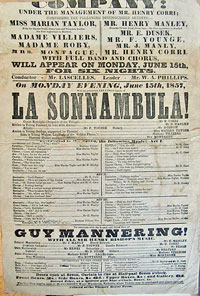
including an appearance at Bradford in the week of June 15, 1857
(playbill opposite)[3]. At the end of 1857, Corri was the subject of bankruptcy
proceedings that included not paying the royalty fees on
the operas they performed[1]. Herberte was dead by that time. |
 |
|
Corri had at least four more management stints: in 1861, 1863,
1865-1867 with Annie Thirlwall and 1867-1869, when he set up
independently again with Ida Gillies, who became his wife in
1869, as primadonna.
London Grand Opera Company
(Elliot Galer) (1856-1861)
One of the manifestations of the touring companies organised by Elliot
Galer [1]
National
English Opera Company (Drury Lane) - (Tully/Kingsbury) (1856-1857)
New National English Opera Company (Tully) (1858)
Grand English Opera
Company / Metropolitan National English Opera Company
(Tully) (1860)
English Opera Company (Manley?/
Pyne?)
(1857)
This company visited south east England in February and March 1857
including Rochester and Canterbury. It included Henry Manley, "the
celebrated tenor", Marian Pyne, W.E. Rosenthal and Juliet Power. It is
not clear who was the manager but Manley or Pyne both had managerial
ambitions.
National English
Opera Company (Escott)
(1858)
The erstwhile
Tully/Kingsbury National English Opera Company was suddenly
terminated by Tully on December 11, 1857 [1] following its 500th
performance. However, the tour continued under the National English
Opera Company banner but with Lucy Escott as manager [2] and with Edward Reyloff
as conductor. The operatic fare continued as before with mainly
continental opera in English but with some English opera including
The Waterman, The Mountain Sylph, The Bohemian Girl and
Maritana. Two members of the company announced their
availability in The Era (June 27, 1858) including the
conductor and there were no further advertisements for the company. Then, on September 9, 1858, the Morning Chronicle wrote that the
company was sailing to the US, where they appeared as the Lucy Escott
English Opera Company[3].
Metropolitan English Opera Company (Lanza, Manley, Bridgman)
(1858 - 1859)
The Reading Mercury (Feb. 13, 1858) wrote about Henry Manley
and his company being in Newbury. Miss Mary Edwin was the prima donna
and F. W. Bridgman was the conductor and pianist. Manley's wife
was also
in the
company. By April, 1858, the Era (Apr. 4, 1858)
announced that an English opera company under the joint
direction of Manley and Bridgman were planning a tour of Kent
with Rosalia Lanza as primadonna as well as Eugene Dussek
Corri, Mr Beale, Mr Coleman, Mr Bentley, Ellen Hodson, Ellen
Payne and Mrs Henry Manley. In early May, 1858, they were in Nottingham [2] where it was said to
be under the direction of Henry Manley and included Marian Pyne, Mr Borrani and Oliver Summers.
They visited Southampton for two weeks at the end of May with Julia Power
advertised as part of the company at that point[3]. They went onto Salisbury for a week, where the company were said to "well merit the hearty applause which they have
received, not only here, but at every place the company has visited"[4]. They then appeared in Huddersfield, Macclesfield,
Preston, Wakefield, Dewsbury, Halifax (where it was said that they had favoured them with a second visit), Derby and Worcester.
Advertised as under the joint management of Miss Lanza, Henry Manley and Frederick Bridgman, it appeared in Shrewsbury the week of
November 7, 1858. The company also included Mrs Manley, Miss Crisp, Miss Charlton, Ellen Payne, Miss Bronti, Hamilton Braham,
Oliver Summers, John Manley, Mr Dobson, Samuel May and Mr Beale. Bridgman was the conductor and pianist. The Era (Nov.14,
1858) carried a short review that commented that "the band and chorus were very efficient". Following Shrewsbury they went to Newport, Cheltenham and Wolverhampton. Thus they visited large towns and smaller cities.
Their
repertoire included La sonnambula, Cinderella, Daughter of the Regiment, Fra Diavolo, Der Freischutz, The Beggar's Opera,
Maritana, The Bohemian Girl, The Waterman and perhaps a little unusually, given how recent they were, Il Trovatore, and
more controversially, La Traviata. Of the latter, when the
company staged it in Derby the
|

Huddersfield, June 26, 1858
British Library Playbills |
following year, the Derby
Mercury (Jan 19, 1859) wrote "Of the very objectionable
plot of this popular opera we need not speak at length... further than
to say that we entirely agree in the severest of strictures
which have
been passed upon it".
Their 1859 tour showed much the same pattern but
there were changes in management. In January, Bridgman left the
company and, by April, so had Miss Lanza, to be replaced as prima donna by Augusta Maitland
and then by Marian Pyne and, by the time of their final appearance in
Weymouth in October 1859, by Mary Edwin. The Theatre
Royal, Exeter, appears to have been in negotiation with them
in December 1859, but nothing came of it.
There was also a U.S. company managed by Henry Savage at the end of the century with the same name.
Grand English Opera Company (Robert Graham)
(1859)
This company included Clara St Casse, Fanny
Huddart, Henry Haigh, Edmund Rosenthal and Oliver Summers with
Frederick Kingsbury as conductor. They seem to have only appeared in Portsmouth in June
1859 and Southampton in July 1959 [1]. It was probably an attempt by
Graham to establish his future wife in an operatic career. If so it did
not succeed and later was mentioned as part of legal proceedings by
Kingsbury for money that he claimed Graham owed him [2].
English
Opera Company (Florence Lancia / Augustus Braham)
(1859-1860)
This company seems to have taken shape at the
Victoria Theatre (Old Vic) in late 1859 and then toured in Dublin and
Glasgow, where they stayed for some weeks. At times they called
themselves the Anglo-Italian opera company and sang some operas in
Italian. They then turned to concert work along with one or two more
singers.
Great (Grand) English
Opera Company (Madame Rudersdorff)
(1860-1861)
According to the Cork Daily Herald
(Dec. 24, 1860) this company was under the
direction of Madame Rudersdorff with Alberto Randegger as conductor. They began touring in the West Country in
August 1860, by September they were in Belfast and Cork by the end of
the year. According to the
Belfast Newsletter (Sep. 29, 1860), the company included Maude
Bishop, Ellen Hodson, Miss Bronte, Fanny Reeves, Inglis Bervon, Mr
Tempest, Mr Bentley, G.A. Cooper, G. Manley, Mr Thompson and Elliot
Galer. Their final date was in Coventry in February 1861. Their
repertoire was mainly continental opera in English but did include a
few of the best known English operas, such as Balfe's The Bohemian
Girl.
Grand English Opera Company (Henry Haigh
/ Elizabeth Haigh-Dyer)
(1860, 1862, 1863,
1864, 1867, 1870-1871, 1874-1876, 1878-1879)
The "Grand" title was
used by different companies. He also used the name National English
Opera Company. Haigh had several attempts at
management. His first was jointly with what was billed as Tully and
Kingsbury's company in 1856-1857 [1]. His next
effort was in 1860 possibly in partnership
with Charles Durand [2] and
with his wife, Elizabeth Haigh-Dyer, as prima donna. Further tours
followed in 1862, 1863, 1864, 1867 and 1870-1872 and in 1874 - 1876 with his English Opera
Recitals company, which staged costumed concert
performances of operas with piano but without a chorus [3]. However, it is
possible that he also sometimes ran a more full scale
company as occasionally it
was advertised as an English Opera Company [4] and, at least once in
March 1875 in Oxford, as the
Drury Lane Opera Company [5]. He also did a short season at the end of 1878
and early 1879
with what he titled The London Drawing Room Opera Company, which
sounds as if its organisation was a reduced affair much like his
Recitals company.
On occasion, e.g. in
Birmingham in 1864 [6], the company was referred to as the Haigh-Dyer Company.
The 1867 company was similarly titled and the 1874-1876 tour sometimes
had one title and sometimes the other. It
is not clear
if that meant that Elizabeth Haigh-Dyer was manager or it was a joint effort
or just reflected that Dyer was the main attraction. The Hampshire Advertiser ( Sep. 8,
1875) styled Haigh as manager and Haigh-Dyer as directress which might suggest
a business and artistic division that is quite familiar today but
would have been more unusual then when the star singer-manager would normally
have had a subordinate "acting manager" to look after business
matters. Certainly Elizabeth's career lasted longer and was fuller
than Henry's and in the later years she may well have been the driving
force.
Their companies played the usual popular continental operas and
English opera although in later years opera bouffe also featured.
English Opera Company (Marian Pyne) (1860)
Pyne sang with the Metropolitan English Opera Company and after that
folded in 1859, began her own company early in the following year,
"a clever but not very strong company of vocalists"[1],
although William Parkinson was her lead tenor. This seems to have come to an abrupt end in Retford
on July 2, 1860 [2], when a
performance of Balfe's The Bohemian Girl drew such a
small audience that the performance was cancelled. On July 20, the
same paper (the Stamford Mercury) announced the advent of the
Braham and Manley company. Hamilton Braham and Henry Manley had been
singing with Pyne and seem to have taken over what remained of her
company.
(Royal) English Opera Company (Hamilton Braham and Henry
Manley) (1860-1862)
Grand English Opera Company
(Hamilton Braham) (1862)
Braham and Manley had been part of the
Metropolitan English Opera Company and Marian Pyne's English Opera
Company. When the latter folded in July 1860 they took over the
company, which sometimes prefaced itself as Royal. It lasted until the spring of 1862. The
Journal (Sep. 30, 1861) claimed that Braham and Manley were the
organisers but that the group was "under the clever management of Mr
W.W. Murray" and that it "had such overflowing success at Sunderland,
that they have been induced to prolong their stay over the coming
week". Apart
from Braham and Manley, his wife, Jane, and brother, John, it had a fairly fluid set of soloists. At
various times, Mary Edwin, Elizabeth Haigh-Dyer and Fanny Ternan were
the prima donnas. The questionable practices of some companies were
made plain when
the Newark Corn Exchange was forced to sue them for £7 for their use of the
building in May 1861 [1]. By March 1862, the company was being titled
Braham's Grand English Opera Company, probably because Henry Manley
was indisposed for around a year starting around that time. Unfortunately the company
fortunes came to an abrupt end with the death of Hamilton Braham on
December 22, 1862.
A preview before their appearance in
Darlington noted that "we cannot venture to predict success here, on
account of the antipathy of the Society of Friends (of which
Darlington is a stronghold) to anything approaching the Dramatic,
though their love of music may lead them to visit the Theatre on such
an occasion" (The Era, June 9, 1861).
The Milner and Cooper Company (1861)
Henry Charles Cooper had been leader of the London Philharmonic Concerts. Cooper and the soprano Ann Milner [1] first met in 1854. In
August 1857 they went to the US where they initially performed in concerts but
the financial situation led them to return to England in the November
[2]. However, they soon changed their minds and go back to the US
where in September 1858 they formed a company to stage
operas at Wallack's Theatre in New York. They had an inauspicious start in New York by offering four Italian operas in English
and only one English opera, The Bohemian Girl, at a time when there were two Italian opera companies in the city. They were
forced to visit more remote places where they could find a more ready audience [3].
On the outbreak of the American Civil War
in 1861, they returned
to the UK where they set up the Milner and Cooper Company, which they advertised in The Era (Aug. 25, 1861) as
"formed for the rendition of the best Operas in the English Language". Two weeks later, The Era listed
the members of the Opera Troupe as it was now titled. As well as Milner, it included Harriet Payne, Miss Bronti, Fanny Reeves,
Elliott Galer, Henry Weston, Aynsley Cook, John Manley. Henry Wharton, Oliver Summers and Mr Raimond. Cooper was the conductor.
Interestingly, the new company was juxtaposed to an advertisement for the London Grand Opera Company, which listed its 8 principal
artists, 6 of whom were in the Milner and Cooper list showing how fluid these companies were as singers tried to ensure they stayed
fully employed. Their tour was mainly confined to Yorkshire, Milner's home county, and lasted much of the rest of the year.
Their repertoire included the usual mix of continental opera in English and English opera, in this case Balfe's The
Bohemian Girl and a new opera, Macfarren's Robin Hood. For some reason, things went awry after the
tour and The Era (Jan. 5, 1862) wrote of their abandoning their planned visit to Ireland.
Probably the company had run out of money as Cooper was declared
bankrupt early in 1862. The company was never reformed
under the Milner and Cooper title.
In 1862, Milner, who was by then living as Cooper's wife even though he was already married, changed her name to Madame Tonnelier
(sometimes Tonnellier). A year later they toured Ireland as part of an English Opera
Company under Mr Burt and in December 1863 they returned to Ireland, this time in charge of the British Operatic Association.
In general, touring companies could not take the financial risk of preparing new operas without strong evidence of their popularity.
However, in both their 1864 and 1869 manifestations the company gave performances in English of
Donizetti's Poliuto, which had been given as I Martiri at Covent Garden in 1852. Following that,
individual numbers and the final scene were sometimes performed over the next 10 years but the opera would have been completely
unknown to the audience perhaps apart from one or two numbers. Probably Cooper liked the opera and hence they made the
effort.
London Royal English Opera
Company (1861)
English
Opera and Burlesque Company (Rosenthal) (1863 - 1865, 1866 -1869, 1873)
Edmund Rosenthal
was an experienced baritone who had several attempts at management. His
first was the London Royal English Opera Company who had been
with Galer's company including Frederick Burgess and Oliver Summers with Fanny Ternan
as their prima donna and Meyer Lutz as conductor. It seems to only
have existed in late summer and autumn, 1861.
His first solo management began in Spring 1863 with performances at the Standard Theatre
in London. The company included Ann Milner (Tonnelier),
Annie Leng and William
Parkinson [1] with James Tully as conductor. Later, the company toured from September 1863.
Elizabeth Haigh-Dyer took over as prima donna but as William Parkinson
remained there was no place for her husband, Henry Haigh. George Cooke
became conductor. In the autumn of 1864, Rosenthal linked up with
Marian Taylor's Burlesque company with the Alessandri sisters as his
lead opera singers and a Mr King as conductor. They toured until
early 1865 when the tour collapsed through lack of funds [2]. By August 1866,
the company was back up
again and performing in Hull with William Parkinson and the Alessandri
sisters as his main stars. Enrichetta Alessandri was almost
immediately replaced by Florence Lancia but returned in 1867 when
Lancia formed her own company. Later, at different times, Elizabeth Haigh-Dyer and Ann Milner as well as Enrichetta Alessandri
occupied the prima donna slot. His company folded again in late 1869
but resurfaced in 1873, 1878 and 1881.
Royal English Opera Company (Jenny Bauer)
[1] (1862)
This appeared at Portsmouth and Brighton in the spring of 1862. It
was a short-lived company possibly because it had quite a sizeable
roster, including Emma Heywood, Miss Clifford, Miss Bronti, Miss
Hodson, Joseph Swift, Mr Terrott, John Manley, Mr Bentley, Edmund
Rosenthal and Theodore Distin. They had an orchestra with George Cooke as conductor.
(English) Lyric Opera Company (1862-1872)
This
first seems to have surfaced in Taunton. Sometimes the title was
prefaced by English and sometimes not. The company included Messrs. R.
Morrow, Leman, Vernon, Dunthorpe, Grantham and W.M. Terrott. Women
included Bertha Purcell, Ada and Louise Travers and Miss
Browning. The conductor was George King.[1] By 1864, Enrichetta Alessandri
was prima donna. The company slowly changed its personnel over the
years but may have been entirely different companies with the same
name. Morrow was the first manager foolowed by Frederick
Addison. For the first few years they stayed in the West Country
and Wales but then moved over to East Anglia before touring more
widely. In 1872, there are no more mentions of the company but a
London Lyric Opera Company made its appearance, which might have been
a follow on. It only seems to have existed in 1872.
English Opera Company (Manley) (1863)
After an absence of over a year, Manley set up yet another company
with Madame B. Purnell as prima donna and J.T. Haines as conductor in
late spring 1863. It seems to have been confined to a few venues in
the north east of England.
English Opera Company (Burt) (1863)
The company made a tour of the main Irish cities in early 1863. The Era (Feb. 15,
1863) describing its visit to Cork referred
to it being under the management of Mr Burt,
although he may just have been the acting manager, i.e. the business
manager. It included Madame Tonnelier (Ann Milner), Emma Heywood, Brookhouse Bowler,
Joseph Swift, Henry Hayes,
Edmund Rosenthal and Charles
Durand. Cooper was the conductor. They seem to have had a good reception, staying
five weeks in Cork. There, almost all the singers were
complemented but the chorus was judged to be "bad all through" and "the orchestra limited but good". At
least some of the success seems to have been down to the staging and the exertions of Mr Angel, the Stage Manager [1].
Grand English Opera Company (Brookhouse
Bowler) (1863)
This had a short season starting in
June 1863 in Birmingham. Elizabeth Haigh-Dyer was prima donna and
Brookhouse Bowler the lead tenor. Another prominent member was the
baritone Charles Durand. The conductor was Emile Berger.
Grand English Opera Company (Henry Corri) (1861-1863,
1868-1869)
This was a company doing a short tour ahead of the Pyne and Harrison
season at Covent Garden as many of the performers were engaged with
them and the operas were in their repertoire. The company included
Annie Thirlwall, Annie Leng, Henry Haigh, Oliver Summers, Charles
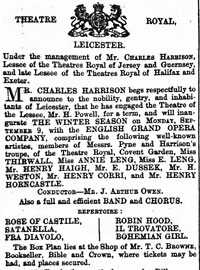
Lyall and Eugene Dussek. In 1861, they were in Leicester
(advertisement opposite - Leicester Chronicle, Sep.
7, 1861), Wolverhampton and Coventry. In 1862, they went to
Nottingham, in 1863 to Liverpool and
Bradford. The Bradford Observer (Oct. 15, 1863) thought that "The company as a
whole, is perhaps hardly equal to Mr. Galer's company who were here
last year".
In 1865, Corri went on with Annie Thirlwall to manage a
more ambitious company with the same title. At some point, he split
off from Thirlwall and in 1868 toured with his own company,
the Royal English Opera Company, with Ida Gilliess as
prima donna. Other members included Herbert Bond, Emma
Heywood, Haydn Corri and John Manley, who doubled as stage
manager.
|
 |
|
British Operatic Association (1864 - 1867,
1869 - 1871)
This company was a successor to the Milner and Cooper Company. It commenced its first
tour in Cork at the end of 1863. At that point it was said to be under the direction of Madame Tonnelier (Ann Milner) [1], although
for much of its life Henry Cooper was the manager. George Loveday was
the secretary for the first year or so. A repertoire of 23 operas was listed including Barnett's The Mountain
Sylph of 1834, popular in its day but a rarity by the 1860s. Nine players were named in the orchestra with Cooper conducting but
possibly they used some local players. Eighteen singers were listed so the chorus must have been small, possibly the nucleus for
local singers to be added. The company toured until May 1865 with Cork visited at the start of 1865,
where it performed Schira's The Orphan of Geneva (1850)[2], probably its first performance for well over 10 years. The company
also had its final performances in Cork in
May. The Coopers then spent until 1869 mainly performing in concerts and music halls.
Early in 1869, they took positions with Rosenthal's Opera and
Burlesque Company but that seems to have folded in December 1869
and Cooper and Milner announced that their
old
company would once again tour beginning with a four week stint in Bath. The orchestra numbered
nine and singers 21, although set
out in a way that suggests some were definitely in the chorus. Perhaps in a sign that the opera was not a sufficient draw, a
burlesque dancer and a comedian were also employed. They toured through 1870 despite a member dying on them. In August 1870 they
announced that they had exclusive rights to the works of Offenbach [3] and, on occasion, included "Offenbach Grand
Opera" in their title. The rest of the year included many performances of Offenbach's The Grand
Duchess, Orphée aux Enfers and La Périchole as well as its usual fare. The tour ended in Cork
in January 1871 and the company was never revived.
Drayton Opera Company
(Henri Drayton) (1864)
Another short lived company managed by Henri Drayton that appeared in
Llandudno , and possibly only Llandudno, in August 1864. It included
Drayton and his wife, Alfred St Albyn, Jenny Carol and Mr
Benson. The conductor was F. Stanislaus. Drayton had had a previous
company in 1855.
Royal English Opera Company
(Limited) (1864-1866)
A proposal for this company had been first floated in July 1861, no
doubt to take advantage of the forthcoming limited liability company rules to contain
any possible losses.[1] Nothing more seems to have been done until the
demise of the Pyne-Harrison company in 1864, when the idea was
resurrected with the Earl of Westmorland at its head. This in turn
foundered but a new proposal with a smaller committee was put forward
which did come to fruition. The company employed many of
the same singers as Pyne-Harrison with Alfred Mellon as their music director and Augustus Harris (senior) as stage manager. They staged
premieres of Macfarren's Helvellyn, Hatton's Rose, or, Love's Ransom and Benedict's operetta
The Bride of Song in 1864 and Leslie's Ida or the Guardian Storks and Clay's operetta,
Constance in 1865. Its demise on February 17, 1866 was marked by several letters in The Era (Feb. 25,
1866) arguing about whose fault it was. They toured a few cities out of season.
Rosenthal's Grand
English Opera and
Burlesque Companies
(1863-1865, 1866-1869)
Rosenthal's company was rather fluid and one gets the impression
that people joined and left as and when they got engagements
elsewhere. At Gloucester on October 26, 1863, the company included Madame Tonnelier, Marian Taylor, Eurichetta Alessandri, Miss Broni and Miss
Tempest with William Parkinson as chief tenor as well as John Manley,
Mr Bentley and Mr Morrow. By Bristol, in
November, Elizabeth Haigh-Dyer was prima donna. At Cambridge in
July no
prima donna was named but Eurichetta and Adele Alessandri[1] had
joined and J. Swift took over from William
Parkinson to be replaced in turn in November by David Miranda from the
US. Marian Taylor became joint manager. The company seemed to have
wound up at the end of 1864 but by February 1865, Rosenthal was
advertising in The Era
(Feb. 12, 1865) for new performers. However, The Era (Feb.
12, 1865) reported that Rosenthal and Taylor were up before Grantham
magistrates for performing in a hall without a licence but defended
themselves by claiming that it was the hall owners who should have
obtained it. In the event, they were fined
£1 9s 6d but gave notice of appeal. Their proposed
visit to Liverpool in March 1865 was abandoned and Rosenthal appeared
in other people's companies including Loveday's. His company
reappeared in July 1866 initially with Florence Lancia and Kate Massoe
as prima donne and Parkinson and Swift as principal tenors. Touring
continued usually to rather less important places until the end
of 1869.
Grand English Opera Company (Loveday)
(1864 - 1870)
George Loveday had been the secretary for the British Operatic
Association when it was first formed in 1863 but then went on to form
his own company. From 1867-1869 he was joint manager with Oliver
Summers. According to the Leeds Intelligencer ( Mar. 11, 1865), performers included Madame Haig-Dyer, Annie
Kemp, Brookhouse Bowler, Henry Rowland, Oliver Summers with George Cooke
as conductor. Operas given included
Faust.
Royal Elysium
Opera Company (Manley, Glover) (1865)
This first appeared in Stockport in January 1865). Besides Henry
Manley and Henry D. Glover, it included Annie Thirlwall as primadonna
but she was soon replaced by Madame Purcell. By June 1865, Manley was
again advertising his availability.
Russell's
English Opera Company (1865-1870)
The first appearance of the company seems to have been in Manchester
in July, 1865. The company there included Florence Lancia, Euphrosyne
Parepa, Mdme Aynsley Cook and Annie Thirlwall with C. Adams, Aynsley
Cook, Henry Haigh and Mr Laurence. Alfred Mellon was the conductor. It
seemed to reappear occasionally mainly in Manchester over the next few
years
Grand London
English Opera Company (Melville) (1865)
Under the management of Henry Melville.
Melville had been with the Loveday company and advertised himself as
"First Low Comedy" and "Principal Second Tenor".[1] The company made its first
appearance at Swansea Theatre Royal where it performed Gounod's Faust
at the end of August 1865.[1]
George Melville, presumably a relative, was manager of the theatre.
The company included Enrichetta Alessandri, Lucy Leffler, William
Parkinson, Henry Rowland, J. Tempest and John Manley. Sidney Naylor
was the conductor. Worcester, Newcastle under Lyme,
Shrewsbury and Macclesfield were the only otherwise advertised
appearances. [2]Madame Tonnelier (Ann Milner) took over from
Alessandri when they got to Worcester [2], Charles Durand took over
from Rowland when they got to Newcastle under Lyme and E. Reyloff took
over from Naylor at Shrewsbury. [4]
English Opera Company (Durand) (1865-1866,
1872-1886),
English Opera Company (Parkinson-Durand) (1868-1869)
Possibly Charles Durand took over the Melville company as there were
several singers in common and its first performances were in December
1865. Durand was one of the performers. Others included Madame Jenny Bauer,
Adele Alessandri, Miss
Hodson, William Parkinson, J. Tempest, John Manley, N. Woods, Mr De Lancey and Mr Horton.
Meyer Lutz was the conductor. The Era (Mar. 25, 1866),
commenting on what may have been its final appearance in Exeter, said
that "The band was too small, but the few played with spirit and
judgment. As a whole, it was a great treat to the Exeter public".
Parkinson together with Durand took over the Thirlwall-Corri
Grand Opera Company (see below) for a short time in November 1868
but there are no notices after January 1869. Durand started up another
company in 1872 and continued in business until 1886, although much
more limited in the 1880s. His company tended to visit more out of the
way places. He left nearly £2400 in his will so looks to
have been one of the few touring managers to have made a success.
Grand English
Opera Company (Thirlwall and Corri) (1865-1869)
Their
first engagement was in Portsmouth in March, 1865[1]. Annie Thirlwall
and Henry Corri were managers and the company included the Aynsley
Cooks, Eugene Dussek (Corri), Charles Lyall and Vernon Rigby with
Meyer Lutz as conductor. It included Mademoiselle Louise as a dancer,
possibly the daughter of Madame Louise, a famous dancer of a previous
era. They were soon joined by Henry Haigh. They toured up
to autumn 1865 and then resumed in March 1866, although initially just
under Thirlwall but then also by Elliot Galer. It also added "Royalty
Burlesque Company" to its title. Fanny Reeves, Annie Kemp and Dussek
were part of the company again conducted by Meyer Lutz. However,
neither Galer nor the additional title stayed very long and by April
it was back to just Thirlwall and then within a month to Thirlwall and
Corri. By the September, no one claimed the management although
Thirlwall was still one of the company and Lutz had been replaced by
Stanislaus. By the end of April 1867, management was again back with Thirlwall and Corri. In Liverpool in October 1867, the company
included Thirlwall, Emma and Fanny Heywood, Henry and Hayden Corri,
Dussek and Herbert Bond with J Pew as conductor [2]. Just after this,
Corri gave up the management in order to start his own company with
Ida Gillies as prima donna. The management of the Thirlwall company
continued to change including under William Parkinson and Charles
Durand for a short while and under her husband Eugene Dussek (Corri) but
engagements seem to have been getting fewer. Thirlwall was still
singing with the company until April 1869 when she moved back to a
permanent career in London.
They had a fairly extensive
repertoire given the size of company but one has to wonder at the
quality as a result. For example. in Liverpool in September 1867, they
claimed to be putting on sixteen operas. They covered quite a range of
continental operas in English (Faust, Il trovatore, Martha, Don
Giovanni, Fra Diavolo, L'elisir d'amore) and less familiar ones,
such as Gounod's Le Médecin malgré lui (The Mock Doctor).
There was also English opera such as The Bohemian Girl, The Rose
of Castille, Maritana and Satanella.
|


